Persistence of vision has been used for a very long time, whether we know about it or not, in our daily lives this happens quite a lot.
What is it?
Persistence of vision is a theory on how our brains and eyes work. The theory states that our eyes keep the image of what we saw a fraction of a second ago to what we are actually seeing now. This means we are supposedly seeing a blend of what we’re looking at now and the thing we looked at 0.04 of a second ago but since the delay is so fast we can’t notice anything unusual.
How it affects us
Since the theory is about our vision and how we interoperate thing, it essentially allows us to see things such as motion pictures and television, without it, we would technically be unable to see movement.
To be able to create the smooth motion in media, the speed of the images per second or frame rate needs to be a minimum of 25 frames per second (1/25 = 0.04), that’s why in very old movies, they seem very jagged and jumpy, their technology then could not allow them to exceed 16 frames per second.
Is the theory true?
The theory has never been scientifically proven and has been labelled more of a myth as some parts seem to make sense.
We’ve now moved on to different theories which could help explain how we see moving images they are known as apparent motion.
Phi Phenomenon
A Phi phenomenon is an optical illusion caused by two non moving objects flashing on and off (disappearing and appearing at the same speed but they can’t both be on at the same time), if the flashing is fast enough the two objects look as if they’re moving back and forth when we know they’re not, this is effectively tricking the brain.
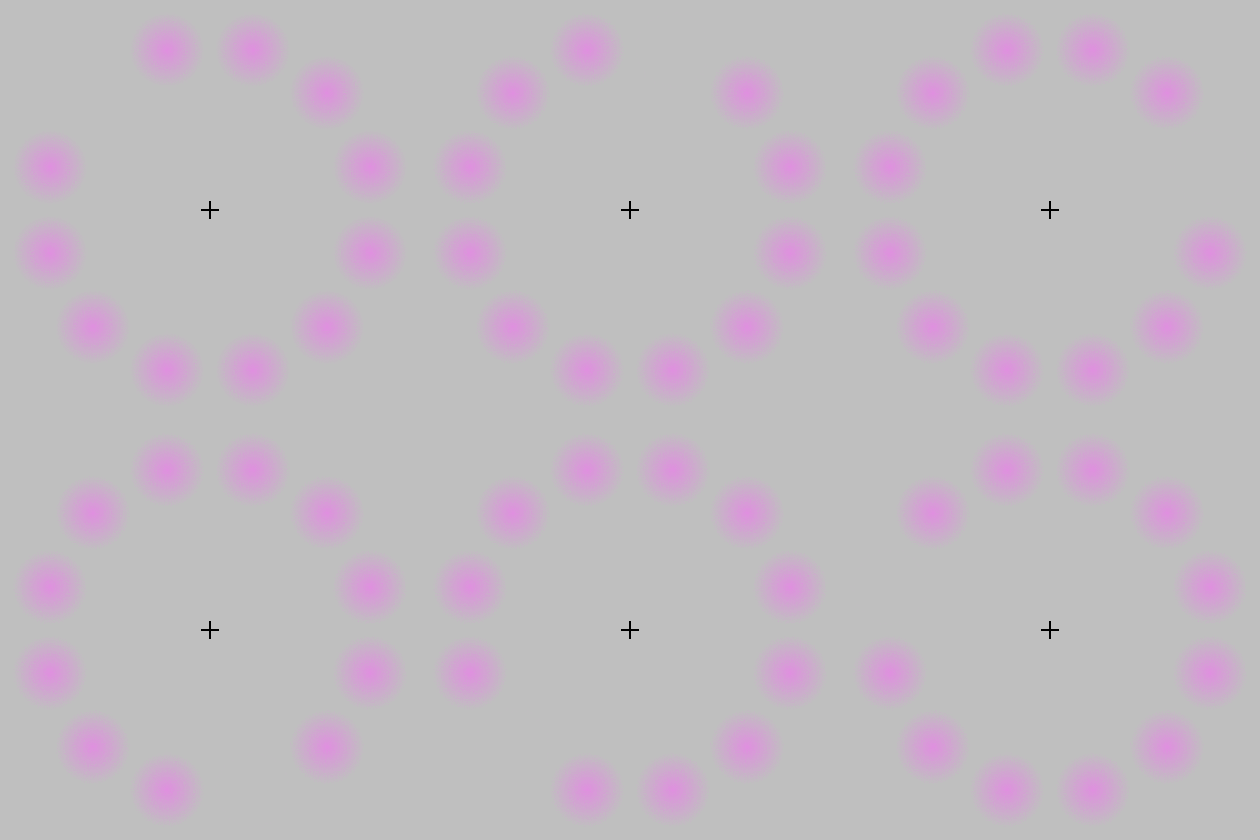
Here is an example of the same technique but with a lot of non moving objects in a circle, the same thing happens but an illusionary circle is created (going clockwise), despite being the same colour as the background it is still visible.
Beta Phenomenon
Beta Phenomenon is when 2 or more objects are on at the same time thorough a sequence (sometimes with more lights), this creates an illusion of movement when the same thing has happened with Phi just with different timing.
Here is an example with several dots, it looks like there is an object moving in the circle, similar to the classic mobile game snake.

If you want to have a play around click here.
In the end, it’s all the just concept of brain automatically doing things without us realising. It’s when we start questioning why, that’s when it starts getting confusing and since there is no scientific evidence so far that supports it, it still doesn't mean its wrong, nor does it mean the other theories are correct, There is still a lot more to be found out.
Bibliography
Phi is not Beta. Phi is not Beta. [ONLINE] Available at: http://www1.psych.purdue.edu/Magniphi/PhiIsNotBeta/index.html. [Accessed 16 March 2012].
Persistence of Vision. 2012. Persistence of Vision. [ONLINE] Available at: http://www.mediacollege.com/glossary/p/persistence-of-vision.html. [Accessed 16 March 2012].
WavyWand™ - How It Works. 2012. WavyWand™ - How It Works. [ONLINE] Available at: http://www.wavywand.com/howitworks.php. [Accessed 16 March 2012].
Z.Allman (2012), "Digital animation", Lecture/Class, De Montfort University, unpublished.
Images
E vidal, (2012), GIF [ONLINE]. Available at: http://en.wikipedia.org/wiki/File:Beta_movement.gif [Accessed 16 March 12].
TotoBaggins, (2012), GIF [ONLINE]. Available at: http://en.wikipedia.org/wiki/File:Lilac-Chaser.gif [Accessed 16 March 12].